The Best of Both Worlds - Analog & Digital

General / 27 June 2026

Using the MetaQuest 3 AR/VR headset to transfer digitally prepped art to an analog substrate. 


In this video, I am demonstrating how I use virtual reality/augmented reality to translate my 3D model that I've created onto an analog substrate such as paper or a canvas. This smaller canvas is going to be my color study for a larger 48"x36" oil painting. I am using the Meta Quest 3, using the StencilVR app. which you can find here: https://www.stencilvr.com/ I work on orientating my digital composition onto the canvas by using the controls within StencilVR and then I rough in the drawing with an HB or B pencil. It gets a little messy, but my goal isn't to be 100% clean but rather block in the shapes of my composition. I will work on refining the drawing and getting the lines cleaner. Then after I do this with my AR/VR headset, I will fix the pencil on the canvas with a fixative so it will not smear.  The subject is to be the DC-8 flown by Samaritan's Purse. (https://www.samaritanspurse.org/media/fact-sheet-dc8/) © 2025 Dale Jackson | StratoArt.com

Here's the hardware & Software I use: 

MH-53J Pave Low III

General / 26 June 2026

This pencil drawing is one that I did for my father who worked in the Air Force on these big helicopters in the 1980s. 

I used to watch these fly overhead where we lived near Hurlburt Field, Florida.  They were huge and they were loud and I loved watching and hearing them. 

Here is some stats on this particular model: "The MH-53J Pave Low III was the largest and most technologically advanced heavy-lift helicopter in the U.S. Air Force inventory. Built for special operations, its primary mission was the undetected infiltration, exfiltration, and resupply of commandos behind enemy lines, as well as complex combat search and rescue (CSAR) missions." (Sikorsky MH-53)

KC-135T 60-0337 "City of Spokane" Profile Edition #3 - MAINTENANCE! Work in Progress - Day One!

Work In Progress / 11 July 2025

KC-135T Edition 3 announcement!

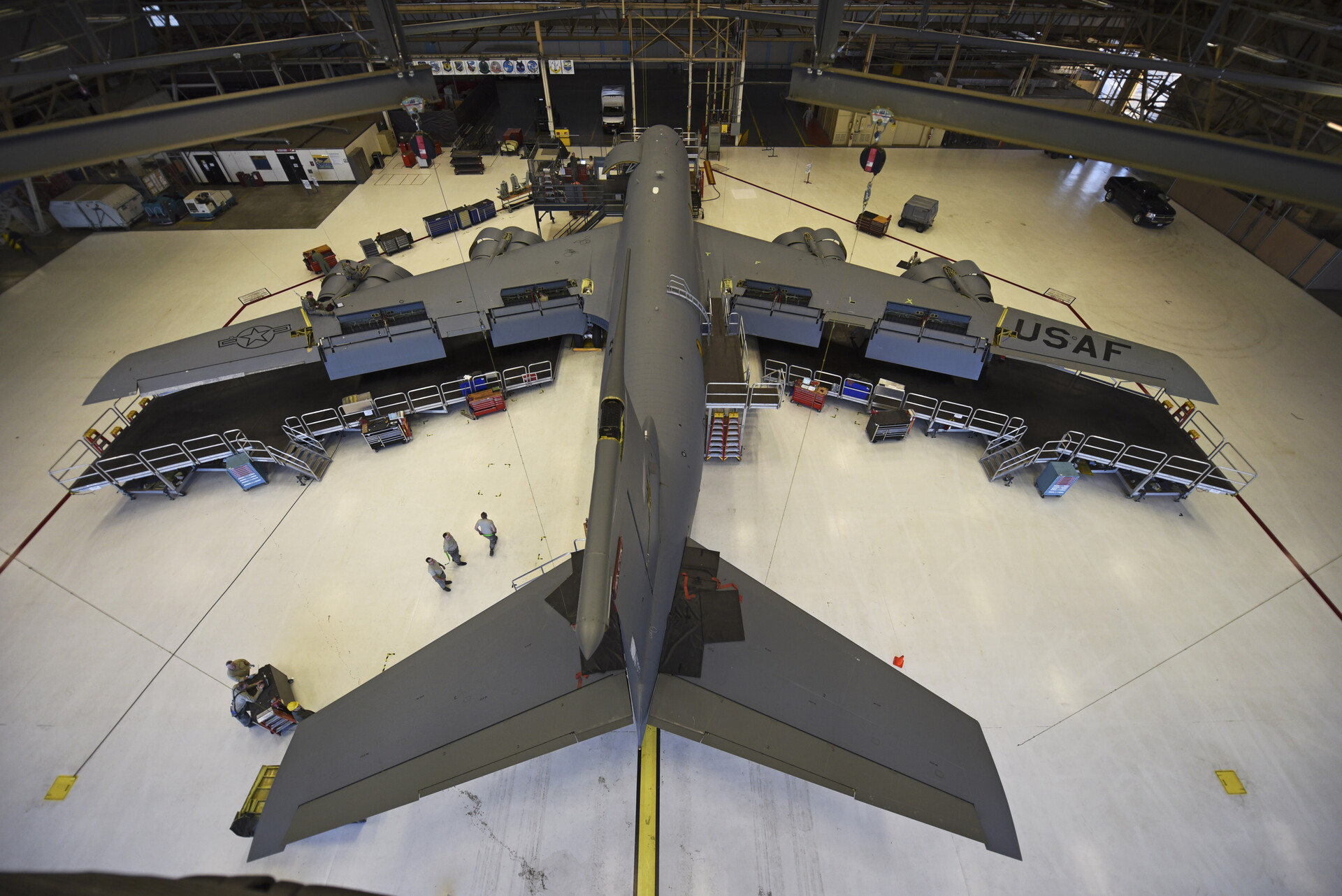
My KC-135T Profiles Edition 1 & 2, aircraft 60-0337 "City of Spokane" are now complete! Now, I'm starting work on Edition #3 which will complete my profile for this particular serial number. The 3rd edition will be "Maintenance" and it will show this aircraft undergoing heavy, detailed inspections and maintenance. I'm thinking of heavy maintenance like a Periodic Inspection (PE) where flaps are lowered, spoilers are raised, panels removed, and engine cowlings open and boom lowered. Also, I would have the cargo bay and crew entry hatch and over wing hatches open. So there's a lot of work to build an interior in 2D. I'm creating these in Photoshop with many layers. So far, my KC-135 profile is 7.16 GB in size at about 48 x 24" at 400 ppi resolution, which is huge! It has over 913 layers with 27 Groups! It's very complex. So with this maintenance piece, I expect that number to increase dramatically. I have been and continue to do research and I'm relying on some memory as well as I used to work on my jet during these periodic inspections and help jack up the jet, remove and reinstall panels, open cowlings, lower the boom, and fix things while the jet was being inspected. 

Here's a good image of what this level of inspection looks like:
Image credit: The 92nd and 141st Maintenance Squadrons and the 92nd Aircraft Maintenance Squadron work on the last periodic inspection of the year Dec. 9, 2015, at Fairchild Air Force Base, Wash. During the initial phase of PE, panels are removed from the jet and Airmen look for discrepancies. Approximately 1,200 maintenance actions are found and completed throughout every PE. (U.S. Air Force photo/Airman 1st Class Mackenzie Richardson) Public Domain.

And if you'd like to check out a video about this kind of inspection on the awesome Stratotanker, see: 

Edition 1

Edition 2


KC-135T "City of Spokane" Profile Art - Edition-2 RELEASED!

General / 11 July 2025

I have finally completed my second profile of the KC-135T "City of Spokane" aircraft serial: 60-0337 as it looked back in 1998. This is the aircraft that I first painted nose art on (1 of 5 aircraft) at Fairchild Air Force base while I was serving as a crew chief on these jets there long ago.

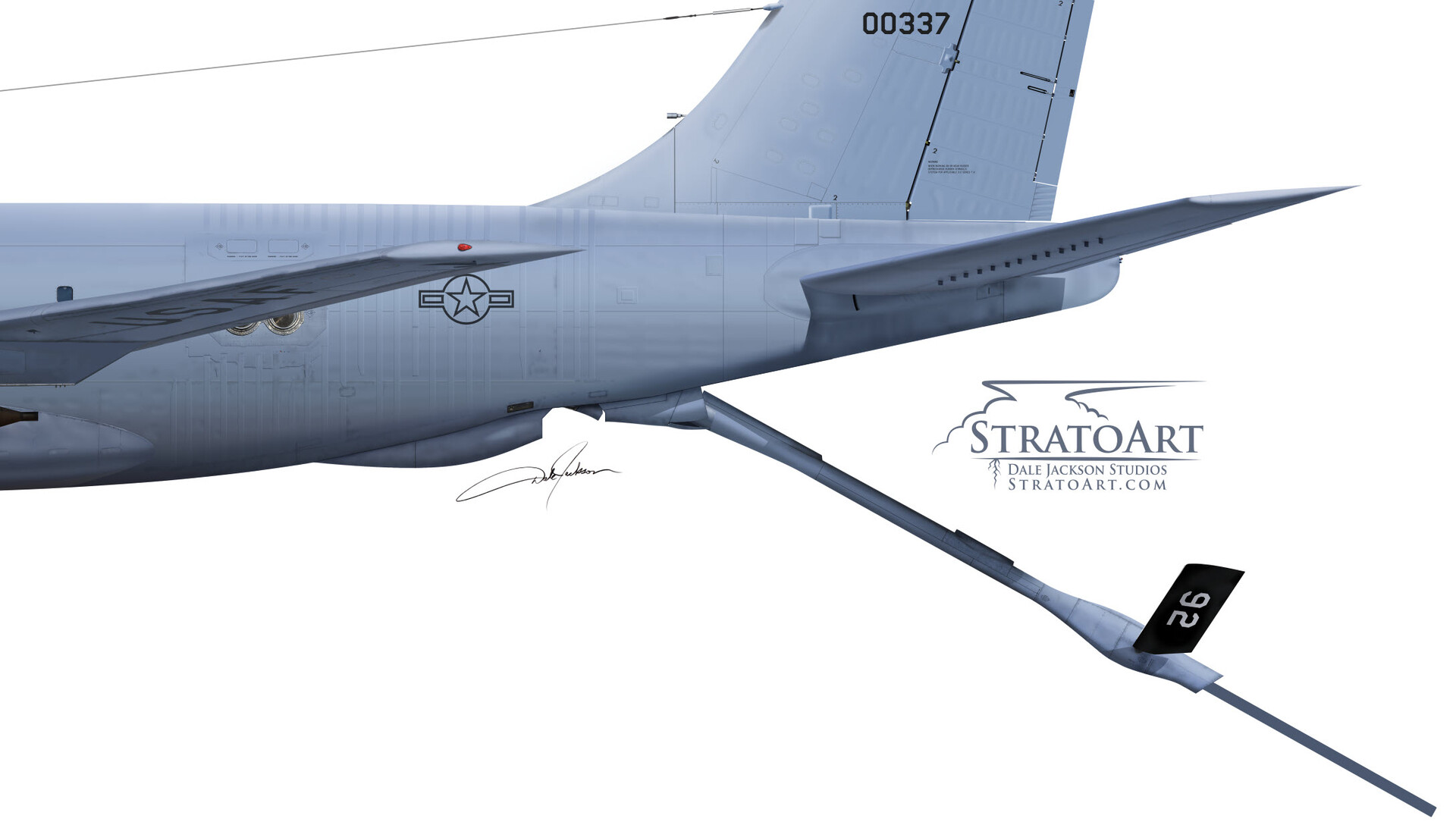
This second edition shows the aircraft flying with gear up and the wing flexed upward and the boom lowered and extended for aerial refueling.


KC-135T "City of Spokane" Profile Art - Edition-2 WORK IN PROGRESS

Work In Progress / 06 July 2025

StratoArt.com

In my last post about my profile art, I mentioned the release of edition-1 of my KC-135T profile illustration.

Today, I'm working on edition-2 which features the KC-135 Stratotanker flying with boom extended. This isn't merely just a copy of the previous piece with the boom lowered. There's quite a bit that I need to develop for this second edition. 

For instance, the wings on large aircraft like the KC-135 flex when flying and so I have to consider this when developing this next part of my profile art of the KC-135. The KC-135 has a significant wingspan of 130 feet, 10 inches. Wing flex is designed into the wings of aircraft like the KC-135 and many large military and commercial jets. Wings are designed to flex to improve aerodynamics, reduce stress on the aircraft structure, and provide a smoother ride for passengers. This flexing is a normal and designed-in feature of aircraft, allowing the wings to adapt to changing airflow and turbulence. 

In addition there are areas behind the wing in my profile art that I need to create that weren't visible before. I had to develop the dual APU exhaust area more as the outer wing flexing upward would reveal more of this area.

For the boom area, I needed to cut and reposition areas where the boom pivots downward during a aerial refuel operation. This is an area that I had to inspect quite a lot during my days as a crew chief on the KC-135. I also need to create the boom shock absorber and the cable that lowers and raises the boom from the fuselage. Where the boom is extended, I need to create the fuel nozzle and the fluorescent markings that are seen on it. These markings are illuminated by two small black lights that are housed up in the shroud area at the end of the boom.

For now in this work in progress update, I have begun to illustrate the flexed wing and I've hidden the gear for flying mode. I've also cut and repositioned the boom for refuel ops. This is a work in progress at the moment, so the refuel shaft or pipe if you will is just a temporary block of grey at the moment. I also needed to reposition the ruddervators. On a KC-135 Stratotanker, ruddervators are small, movable airfoil surfaces located on the end of the refueling boom. They are controlled by the boom operator and used to precisely guide the boom into position for aerial refueling with another aircraft. The ruddervators are crucial for the KC-135's ability to perform its primary role as an aerial refueling tanker. Since they are, in essence, like wings, they do move or pivot on their axis in accordance with the Boomer's controlling them from the boom pod. They Boomer literally flies the boom in position for the refuel operation.

I am using both Adobe Illustrator and Adobe Photoshop to produce this profile art.

Below are some screen captures of my work in progress on Edition-2 of the KC-135. 



KC-135T "City of Spokane" Profile Art - Edition-1

General / 05 July 2025

StratoArt.com

After a long time working on this, I've finally completed my first KC-135 Profile art. Specifically, this is a KC-135T Stratotanker that I hand-painted the nose art on back in 1998, "City of Spokane."  Prints are available here: https://pixels.com/featured/kc-135t-60-0337-edition-1-dale-jackson.html

It is aircraft 60-0337 and in 1998 it belonged to the 92d Aerial Refueling Wing based at Fairchild Air Force Base. I actually painted art on five lead aircraft of each squadron based at FAFB back in 1998, and this one "City of Spokane" was perhaps my favorite and the art continued on after my service time. I learned years later that my art was faithfully recreated as a decal and put on aircraft 58-0092 and then on 58-0094, years later after I originally painted it on 60-0337.

I was a crew chief on the KC-135 aircraft back in the 1990s, based at Altus and then Fairchild. It was an honor and privilege to paint art on five jets there at Fairchild AFB, and it's been a labor of love to create this profile art.

After tedious studying and referencing, taking many walkaround photos of a nearby KC-135 now at the National Museum of the United States Air Force, I finally have completed my work on this first KC-135 profile "City of Spokane." I have plans to do other KC-135 profiles as well including A and E models as well as several more R models at different bases.

Here are a few views of the details of this very large 50" digital profile. Every area of the art was meticulously researched for the era. USAF aircraft, like it's personnel are constantly on the move, changing, and advancing. At this time in 1998, the KC-135 fleet was undergoing a large avionics upgrade. Twenty seven years later, today's Stratotankers may look the same externally, but internally they have undergone much advancement. Externally, much remains the same with exception of a few new antenna and other modifications that reflect the the modifications made internally.

The C-135 fleet of aircraft with all it's diverse mission variations remains one of the most venerable aircraft of the United States Air Force!

NKAWTG! Nobody! 

Here's a newspaper clipping of me standing by my art and the jet I painted it on back in 1998.


F-105G Walkaround

General / 06 April 2021

F-105G Thunderchief Walkaround by Dale Jackson at the National Museum USAF.

F-105G Walkaround at the USAF Museum

"The F-105, nicknamed the "Thud," evolved from a 1951 project by to replace the F-84F fighter-bomber. The prototype first flew in October 1955, and Republic delivered the first production aircraft to the U.S. Air Force in 1958. Republic also developed a fully combat-capable two-seat trainer version, the F-105F, and 143 of them in 1963-1964.

The Thunderchief on display began operational service in 1964 as a standard F-105F. In 1967 it joined the 355th Tactical Fighter Wing in Thailand, where it flew combat missions for nearly three years. During this time, it became one of a select few USAF aircraft to claim three MiG kills. In 1970 it was fitted with electronic counter-measure equipment and joined the 388th TFW for "Wild Weasel" duty, attacking enemy surface-to-air missile sites. 

In 1972 the aircraft was modified to the improved F-105G "Wild Weasel" configuration. After another year in Thailand, it was assigned to the 35th TFW at George Air Force Base, Calif. It remained there until February 1980 when it was flown to the museum. It is marked as it appeared while assigned to the 561st Tactical Fighter Squadron based at Korat Royal Thai Air Force Base, Thailand, in 1972-1973."
(National Museum of the United States Air Force description / NMUSAF)

TECHNICAL NOTES:
Armament: One M61 20mm Vulcan cannon and over 12,000 lbs. of ordnance
Engine: One Pratt & Whitney J75-P-19W of 26,500 lbs. thrust 
Maximum speed: 1,386 mph
Cruising speed: 596 mph
Range: 1,500 miles
Ceiling: 50,000 ft.
Span: 34 ft. 11 in.
Length: 67 ft.
Height: 20 ft. 2 in.
Weight: 54,580 lbs. maximum
Serial number: 63-8320


EA-6B Prowler

Making Of / 24 March 2021

StratoArt.com

After a bit of a break from art, I returned to it jumping right into a big 24" x 18" drawing of an EA-6B Prowler nearly launch from a carrier. 

The EA-6B Prowler was the primary tactical jamming aircraft of the US Navy and the US Marine Corps from the early 1970s to 2019. The Prowler first entered service in the 1971 and has demonstrated its battlefield performance in Southeast Asia, in Operation Desert Storm, in Bosnia-Herzegovina and in Kosovo, enforcing the northern no-fly zone over Iraq and in Operation Iraqi Freedom. The USN had a fleet of 124 Prowlers which equipped USN aircraft carriers, forward land bases and the US Marine Corps squadrons. The aircraft was retired in 2019 and replaced by the EA-18G Growler, an electronic attack version of the F/A-18 Super Hornet.

Here is a short, two minute video time-lapse of the whole process. It took approximately 25 hours to draw, working on it off and on since Feb. 26th.